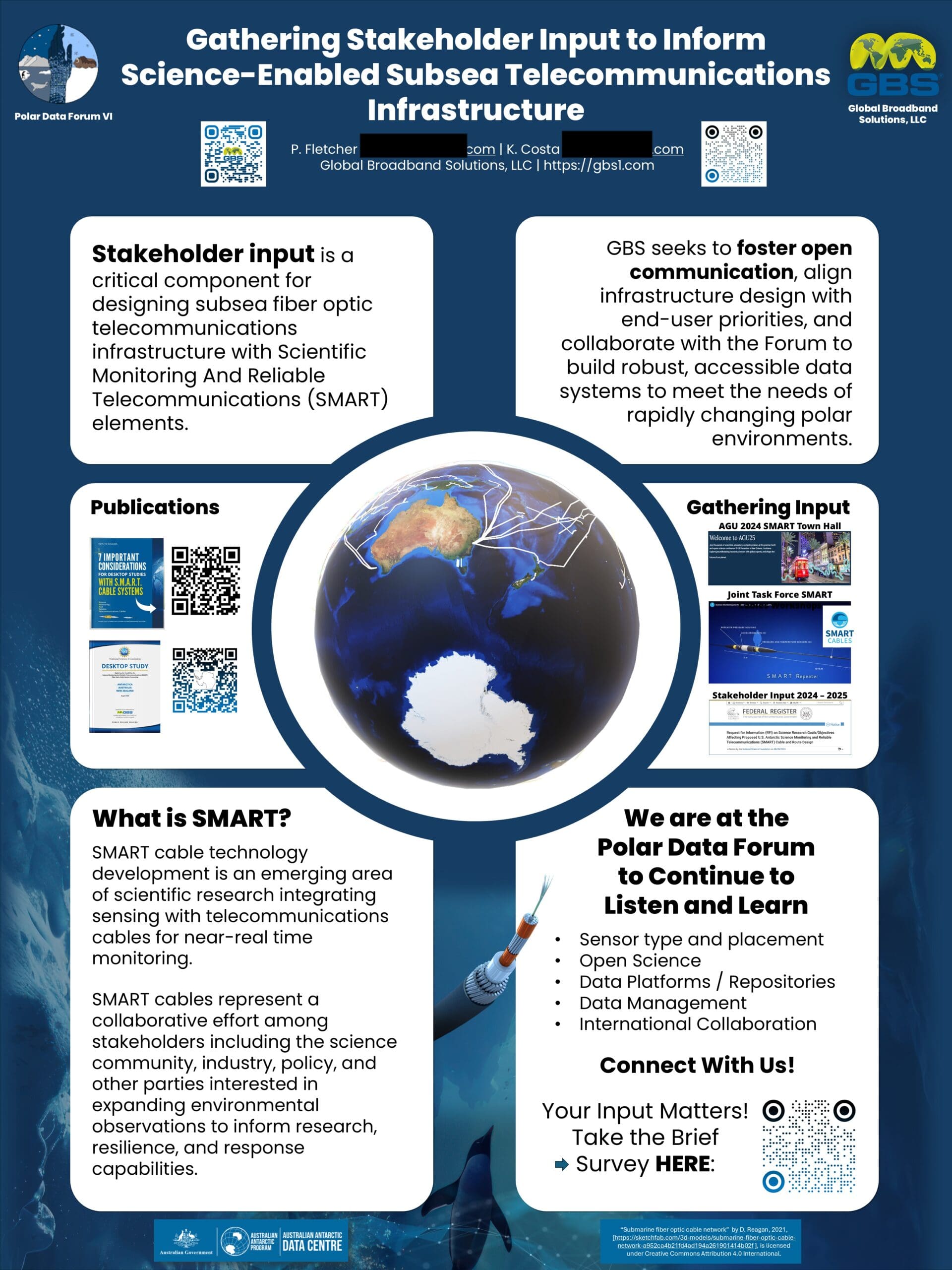
Welcome: Polar Data Forum VI!
If you've come to this page through a Conference Poster QR code, we appreciate your willingness to help inform the design of a proposed telecommunications cable across the Southern Ocean!
This survey is part of an ongoing effort to gather input related to telecommunications infrastructure that may be constructed as a "SMART" (Science Monitoring And Reliable Telecommunications). SMART cables can be used to monitoring ocean bottom temperature, pressure, and seismic activity. They may include Branching Units (BUs) are components that allow for branches off the telecommunications cable, providing high bandwidth and power to connected instrumentation. Beyond scientific research, SMART cables are expected to have broader societal impacts, including enhancing education and engagement by providing robust bandwidth for data gathering and outreach opportunities.
The following brief survey, which builds upon previous workshops and studies, seeks to gather diverse perspectives and input from experts and interested individuals to help understand the needs of potential end-users. Your responses will contribute to shaping the future design and implementation of this unique research infrastructure. All identifying information is optional.
GBS is pursuing SMART Cable initiatives prioritizing
Environmental Responsibility | Technological Advancement |Scientific Research
GBS is pursuing SMART Cable initiatives prioritizing
Environmental Responsibility | Technological Advancement |Scientific Research
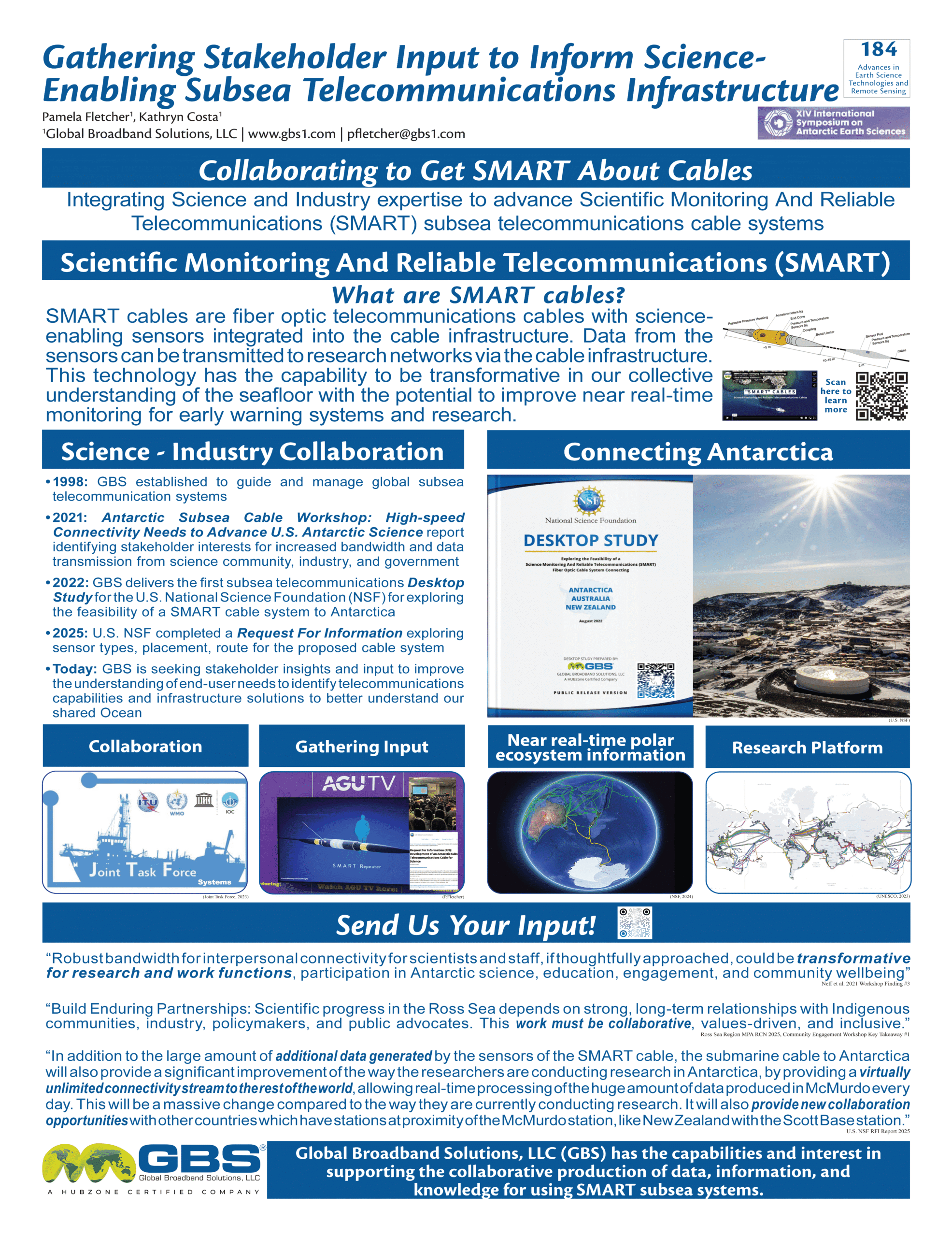
Welcome: XIV International Symposium on Antarctic Earth Sciences Participants!
If you've come to this page through a Conference Poster QR code, we appreciate your willingness to help inform the design of a proposed telecommunications cable across the Southern Ocean!
This survey is part of an ongoing effort to explore the value and feasibility of deploying a submarine fiber optic cable system to McMurdo Station in Antarctica. Currently, scientific research in Antarctica is severely limited by network bandwidth bottlenecks, and this project aims to provide high-speed internet connectivity to address these constraints.
A key aspect of this proposed infrastructure is that it could be constructed as a "SMART" (Science Monitoring And Reliable Telecommunications) cable. This means the cable would have embedded sensors that could observe the ocean and Earth between New Zealand and Antarctica, enabling meaningful new research, especially in the Southern Ocean. These sensors could measure things like ocean bottom temperature, pressure, and seismic activity.
Branching Units (BUs) are components that allow for branches off the main subsea fiber optic cable, providing high bandwidth and power to connected instrumentation. Their purpose and potential in the Antarctic Subsea Cable project include enabling modular expansions for new research stations and autonomous platforms, deploying diverse scientific sensors for deep-ocean monitoring across various disciplines like oceanography and seismology, and effectively "future-proofing" the system to accommodate unforeseen technologies and extend spatial observation over its 25+ year lifespan.
Beyond scientific research, the project is also envisioned to have broader societal impacts, including enhancing education, engagement, and community well-being by providing robust bandwidth for interpersonal connectivity and outreach opportunities.
The following brief survey, which builds upon previous workshops and studies, seeks to gather diverse perspectives and input from experts and interested individuals to help refine the project's objectives and understand the needs of potential end-users. Your responses will contribute to shaping the future design and implementation of this unique research infrastructure. All identifying information is optional.
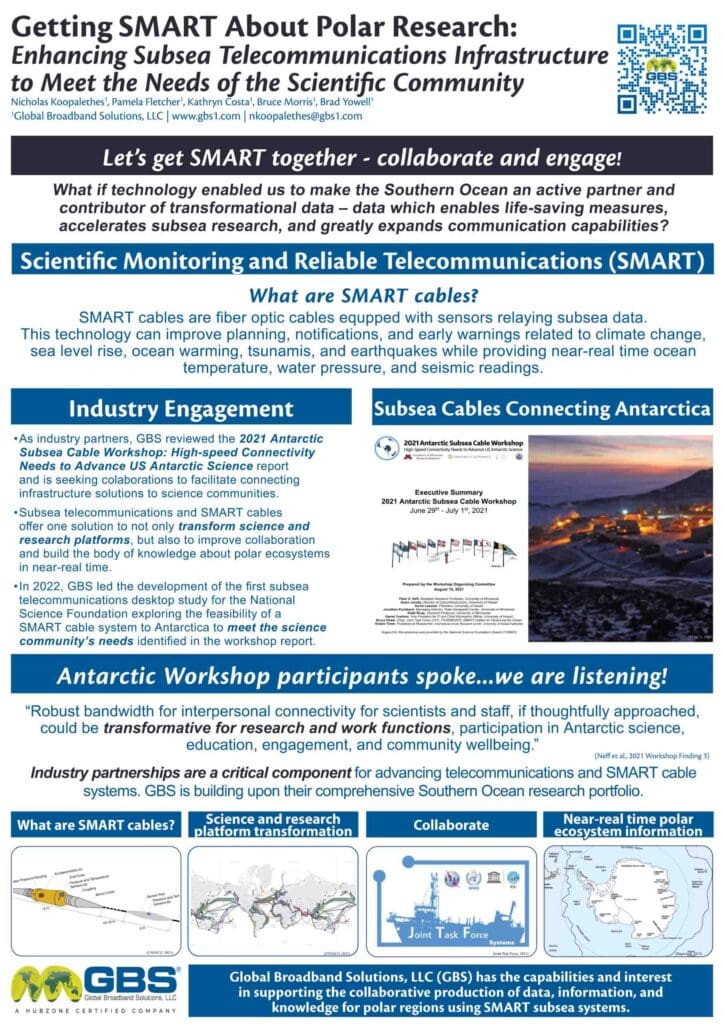
GBS SMART Cable Poster Presentation for the Polar Data Forum 2023 Event
GBS is pleased to participate in the 2023 Polar Data Forum with a SMART cable poster presentation:
Getting SMART About Polar Research:
Enhancing Subsea Telecommunications Infrastructure to Meet the Needs of the Scientific Community
Collaboration is key to the success of SMART cables. Individuals and organizations (such as Bruce Howe at University of Hawaii, NOAA, etc.) have built a foundation for SMART cable development. At GBS we see ourselves as an industry partner – who understand the necessary infrastructure to design, build, install and maintain cable systems. GBS is seeking partnerships in support of meeting the needs of the science community through our expertise in subsea cable systems.
EMERGING, TRANSFORMATIVE TECHNOLOGY
SMART CABLES
SMART cable technology development is an emerging area of scientific research utilizing a sensor network that is integrated into a submarine fiber optic cable (SFOC) system to collect scientific data. This near-real time monitoring can have a transformative effect on understanding and planning related to climate change, sea level rise, ocean warming, earthquakes and tsunamis.
SMART cables represent a collaborative effort between the scientific community, telecommuncations experts, SFOC suppliers, and other parties interested in expanding environmental monitoring capabilities.
What are SMART Cables?
Video: 1 Minute
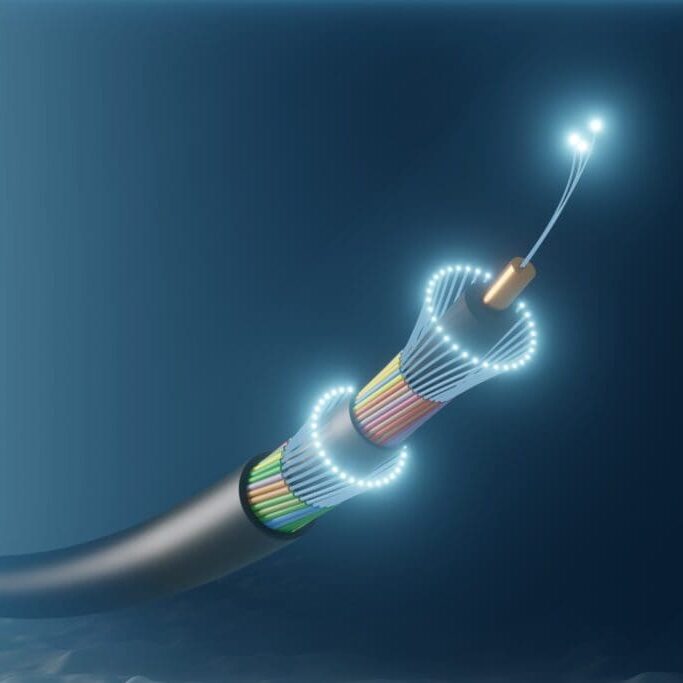
What are SMART Cables?
7 Desktop Study Considerations when planning for a SMART cable system >

Listening to the Ocean Floor
Climate change, sea level rise, marine modeling, early warnings - just a few transformative applications of SMART cable technology.
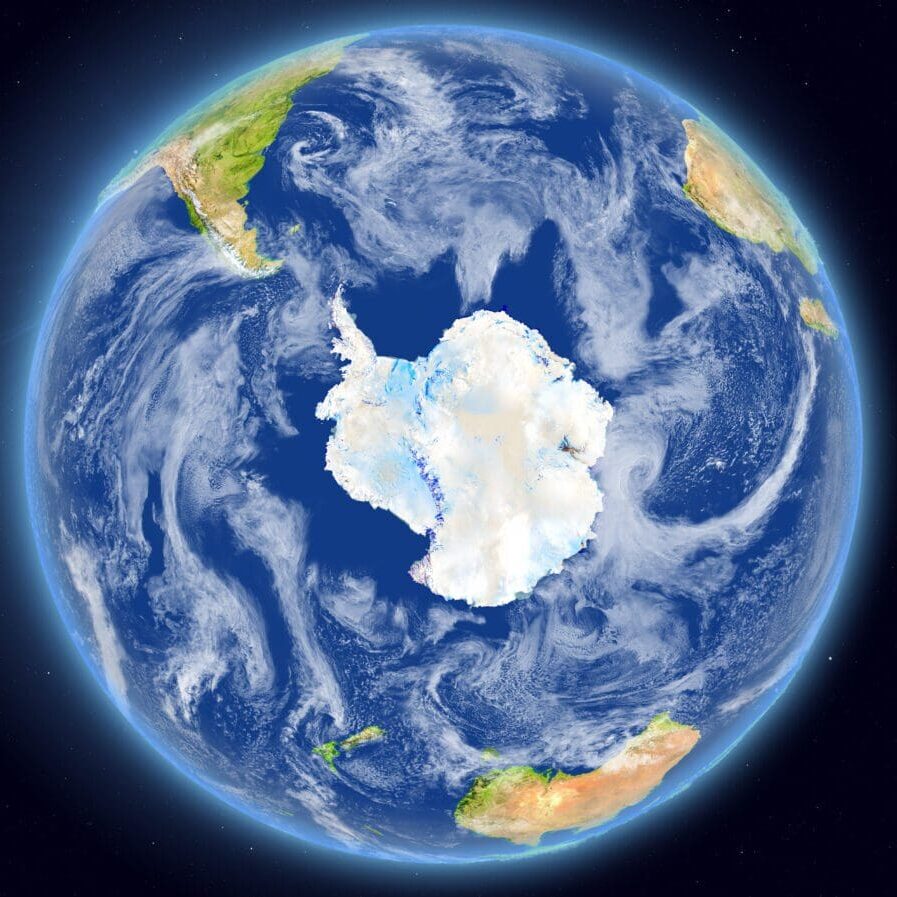
Latest News
SMART Cable to Antarctica - Public Release Version of the GBS Comprehensive Desktop Study is now live online. READ MORE
Polar Data Forum. GBS Poster Presentation, "Getting SMART About Polar Research: Enhancing Subsea Telecommunications Infrastructure to Meet the Needs of the Scientific Community." Rewatch SMART Cables and the Southern Ocean >